
Delta Engineering — Designing Your Night to Train Tomorrow’s Brains
Your morning mind is compiled the night before. If your code runs slow, it’s rarely a coffee problem, it’s a Delta problem.

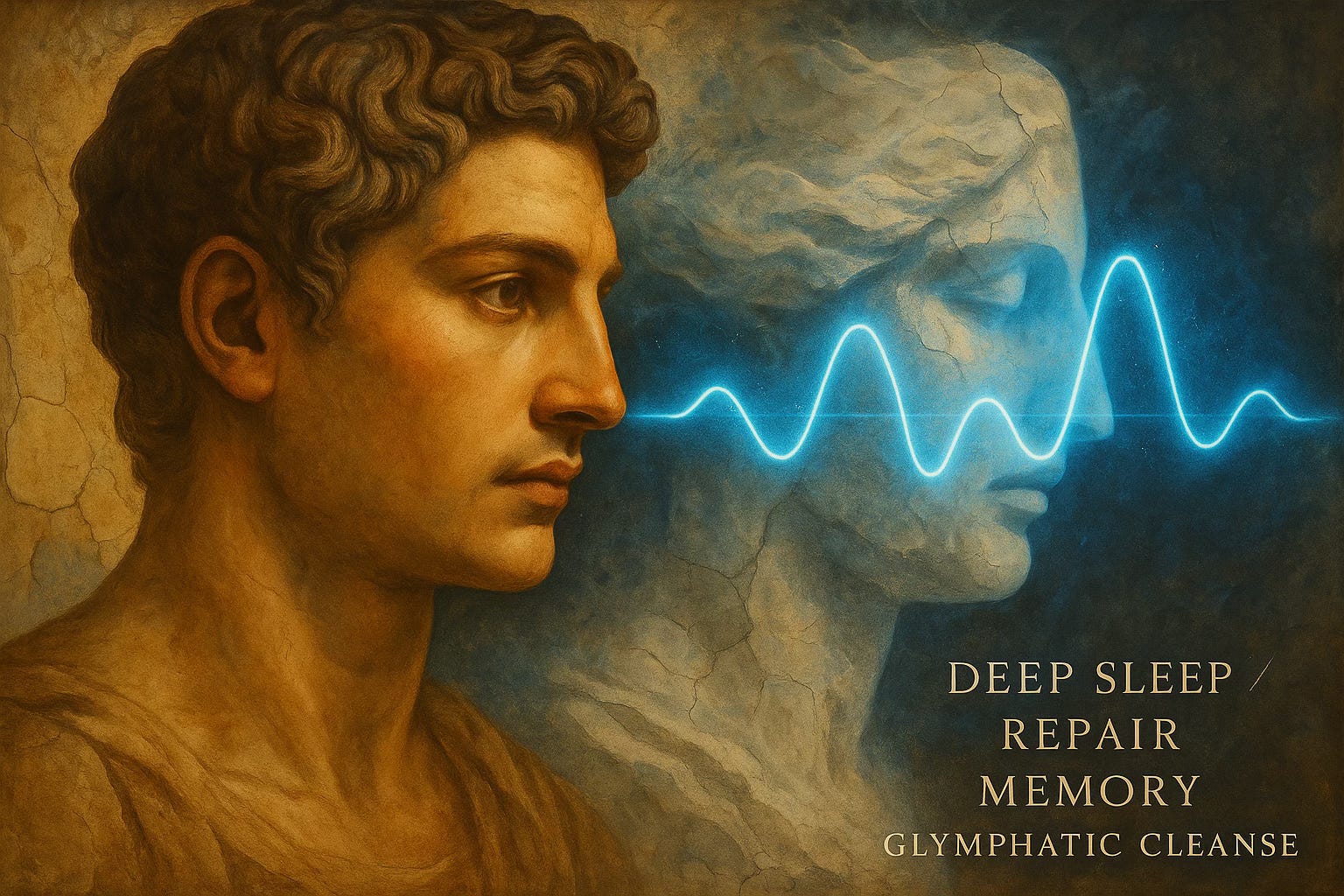
Delta waves (0.5–4 Hz) are the body’s night-shift operating system, running deep in slow-wave sleep (SWS). They’re the quiet engineers behind growth, memory consolidation, and metabolic clean-up. If you skip them, you’re booting tomorrow’s brain from a corrupted disk.
Today we’ll break down:
What Delta actually does (and why it matters tomorrow)
The three “master levers” you can pull every night
The 90-minute slope to Delta
Nap rules (and when to avoid them)
Gadgets, screens, and evening training—myth vs. signal
A copy/paste Night Architecture Blueprint you can run tonight
1. What Delta Actually Does
Delta is more than “deep sleep.” It’s the stage where your system rebuilds itself on multiple fronts:
a) Growth & repair
Slow-wave sleep triggers pulses of growth hormone, particularly in the first half of the night. These aren’t just for kids—they drive tissue repair, muscle recovery, and immune recalibration.
b) Memory and synaptic tuning
In SWS, the hippocampus hands off short-term memories to the cortex for long-term storage. At the same time, synapses are pruned—removing “noise” so that tomorrow’s signals travel faster.
c) Glymphatic clearance
Delta rhythms drive cerebrospinal fluid through the brain, flushing metabolic waste like amyloid-β and tau. Noradrenergic pulses act as the pump. Think of it as a nightly coolant flush for the CPU.
2. The Three Master Levers
Everything you do in the last 2–3 hours before bed influences Delta depth and timing. The biggest control dials are:
Light — spectral quality & timing
After sunset: reduce blue-cyan (~470–500 nm) light; dim overall levels; keep lights low and to the side.
Morning: 10–30 min of outdoor light within 60 minutes of waking anchors your circadian clock.
Why: Evening melanopic light suppresses melatonin and shifts your sleep phase later; morning light advances it.
Temperature — core vs. skin
Warm shower/bath 60–90 min pre-bed → skin vasodilation → faster core cooling → shorter sleep latency.
Keep bedroom 18–20 °C; cooler temps help initiate SWS.
Why: A drop in core body temperature signals readiness for deep sleep.
Chemistry — inputs & timing
Caffeine: stop by late morning; afternoon/evening intake cuts deep sleep even in “non-sensitive” people.
Alcohol: fragments REM and disrupts SWS even at low doses.
Supplements: magnesium glycinate and tart cherry have mild, situational benefits; use as adjuncts, not anchors.
3. The 90-Minute Slope to Delta
Deep sleep isn’t a switch—it’s a descent. You can design that descent to reliably arrive in Delta territory.
Breath: 4-sec inhale, 6–8-sec exhale, 5–10 minutes (~6 breaths/min) to raise HRV and engage the vagal brake.
Body: yin stretches or slow mobility; avoid anything that spikes heart rate.
Mind: “Closure list”—tomorrow’s 3 priorities + 1 line of gratitude to offload mental loops.
Soundscapes: Pink noise or nothing. Closed-loop slow-oscillation cues are promising in some studies, but keep volume low and skip 40 Hz flicker at night.
4. Naps as a Delta Dividend
Short naps can protect attention and performance—if you time them right:
10–20 min for a quick alertness boost.
Avoid naps after ~15:00 if night sleep is fragile.
NASA cockpit studies show controlled naps improve reaction times, even in demanding environments.
5. Gadgets, Screens, and Evening Training
Training: Moderate workouts are fine in the evening if finished ≥1–2 h before bed. High-intensity work late can trim REM.
Screens: Dim brightness, reduce melanopic content, or shift to grayscale. But light positioning and intensity matter more than blue-blocking glasses alone.
Wearables: Use for trends, not nightly judgment. Your goal is daytime function, not chasing a perfect score.
6. Delta-First Night Architecture
Here’s the copy/paste blueprint:
T-120 to T-90 — Kitchen closed; lights dim & amber; no overheads.
T-90 — Warm shower/bath (10–15 min). Bedroom pre-cooled to 18–20 °C.
T-60 — Breathing practice + gentle stretches.
T-45 — Paper book or closure list.
T-30 — Pink noise or quiet.
T-0 — Blackout shades; phone charging outside; no alcohol nightcap.
AM anchor — Outdoor light + movement within an hour of waking.
Folklore × Molecule
The monks’ vespers lit only by candle. Roman villas cooled by night air. Same physics, different vocabulary:
Dim photons
Shed heat
Clear the cache
Delta isn’t mystical—it’s mechanical. But if you protect it, it feels like magic.
Subscribe & share if you want more sleep × design × deep-tech science in your feed.
Delta Engineering — Progettare la notte per allenare il cervello di domani
La tua mente del mattino si compila la sera prima.
Se il tuo “codice” gira lento, non è quasi mai un problema di caffè—è un problema di Delta.
Le onde Delta (0,5–4 Hz) sono il sistema operativo notturno del corpo, attivo durante il sonno a onde lente (SWS). Sono gli ingegneri silenziosi dietro crescita, consolidamento della memoria e pulizia metabolica.
Se le salti, stai avviando il cervello di domani da un disco corrotto.
Oggi vediamo:
Cosa fa davvero il Delta (e perché conta il giorno dopo)
Le tre “leve maestre” da azionare ogni notte
La discesa di 90 minuti verso il Delta
Le regole del pisolino (e quando evitarlo)
Gadget, schermi e allenamento serale — miti e segnali
Un Blueprint Notturno Delta-first pronto da copiare
1. Cosa fa davvero il Delta
Il Delta è molto più del “sonno profondo”. È la fase in cui il sistema si ricostruisce su più fronti:
a) Crescita e riparazione
Il sonno a onde lente attiva impulsi di ormone della crescita, soprattutto nella prima metà della notte. Non serve solo ai bambini—guida la riparazione dei tessuti, il recupero muscolare e la ricalibrazione del sistema immunitario.
b) Memoria e ottimizzazione sinaptica
In SWS, l’ippocampo trasferisce i ricordi a breve termine alla corteccia per l’archiviazione a lungo termine. Contemporaneamente, le sinapsi vengono potate—rimuovendo il “rumore” così che i segnali domani viaggino più veloci.
c) Drenaggio glicmfatico
Le onde Delta spingono il liquido cerebrospinale attraverso il cervello, eliminando scorie metaboliche come beta-amiloide e tau. Impulsi noradrenergici agiscono come pompa. È come un “flush” di raffreddamento per la CPU.
2. Le Tre Leve Maestre
Tutto ciò che fai nelle 2–3 ore prima di dormire influenza profondità e timing del Delta. Le leve più potenti:
Luce — qualità spettrale e tempistica
Dopo il tramonto: riduci luce blu-ciano (~470–500 nm); abbassa i livelli complessivi; tieni le luci basse e laterali.
Al mattino: 10–30 min di luce naturale entro 60 minuti dal risveglio per ancorare l’orologio circadiano.
Perché: La luce serale ad alto contenuto melanopico sopprime la melatonina e ritarda la fase del sonno; la luce mattutina la anticipa.
Temperatura — core vs. pelle
Doccia o bagno caldo 60–90 min prima di dormire → vasodilatazione cutanea → raffreddamento rapido del core → addormentamento più veloce.
Mantieni la stanza 18–20 °C; il fresco favorisce l’avvio dell’SWS.
Perché: Il calo della temperatura corporea segnala prontezza al sonno profondo.
Chimica — input e timing
Caffeina: stop entro fine mattinata; assumerla nel pomeriggio/sera riduce il sonno profondo anche nei “non sensibili”.
Alcol: frammenta il REM e altera l’SWS anche a basse dosi.
Integratori: magnesio e succo di ciliegia tart hanno benefici lievi e situazionali; usali come supporto, non come base.
3. La Discesa di 90 Minuti verso il Delta
Il sonno profondo non è un interruttore—è una discesa. Puoi progettarla per arrivare in Delta in modo affidabile.
Respiro: inspira 4 sec, espira 6–8 sec, per 5–10 min (~6 respiri/min) per alzare l’HRV e attivare il freno vagale.
Corpo: stretching yin o mobilità lenta; evita picchi di frequenza cardiaca.
Mente: “Closure list”—3 priorità di domani + 1 riga di gratitudine per scaricare i loop mentali.
Suoni: Rumore rosa o silenzio. Stimoli acustici a oscillazione lenta mostrano risultati promettenti, ma tieni il volume basso e niente flicker a 40 Hz di notte.
4. Pisolini come Dividendo Delta
Pisolini brevi proteggono attenzione e performance—se temporizzati bene:
10–20 min per un boost di prontezza.
Evita dopo le ~15:00 se il sonno notturno è fragile.
Gli studi NASA mostrano che sonnellini controllati migliorano tempi di reazione anche in contesti ad alta pressione.
5. Gadget, Schermi e Allenamento Serale
Allenamento: Moderato ok in serata se finito ≥1–2 h prima di dormire. L’intenso troppo tardi può ridurre il REM.
Schermi: abbassa luminosità, riduci contenuto melanopico o passa in scala di grigi. Ma posizione e intensità della luce contano più degli occhiali “blue-blocker”.
Wearables: usali per trend, non per giudicarti ogni notte. L’obiettivo è funzionare di giorno, non il punteggio perfetto.
6. Blueprint Notturno Delta-first
T-120 → T-90 — Cucina chiusa; luci basse e calde; niente plafoniere.
T-90 — Doccia/bagno caldo (10–15 min). Camera pre-raffreddata a 18–20 °C.
T-60 — Respiro guidato + stretching dolce.
T-45 — Libro cartaceo o closure list.
T-30 — Rumore rosa o silenzio.
T-0 — Tende oscuranti; telefono fuori stanza; niente alcol “rilassante”.
AM anchor — Luce e movimento all’aperto entro un’ora dal risveglio.
Folclore × Molecola
Vespri monastici illuminati da candele. Ville romane raffrescate dall’aria notturna. Stessa fisica, vocabolario diverso:
Pochi fotoni
Perdita di calore
Cache svuotata
Il Delta non è mistico—è meccanico. Ma se lo proteggi, sembra magia.
Se vuoi il prossimo episodio di questa serie, passeremo da Delta → REM per vedere come il turno “onirico” del cervello riscrive la realtà.
Iscriviti e condividi se vuoi più scienza di sonno × design × deep tech nel tuo feed.